Inside the Molecular Battle Against Bathroom Steam
A materials science look at why moisture-engineered composite cores hold their shape in humid bathrooms while wood slowly breaks down.
Why Wood Fibers Lose the Fight Against Steam
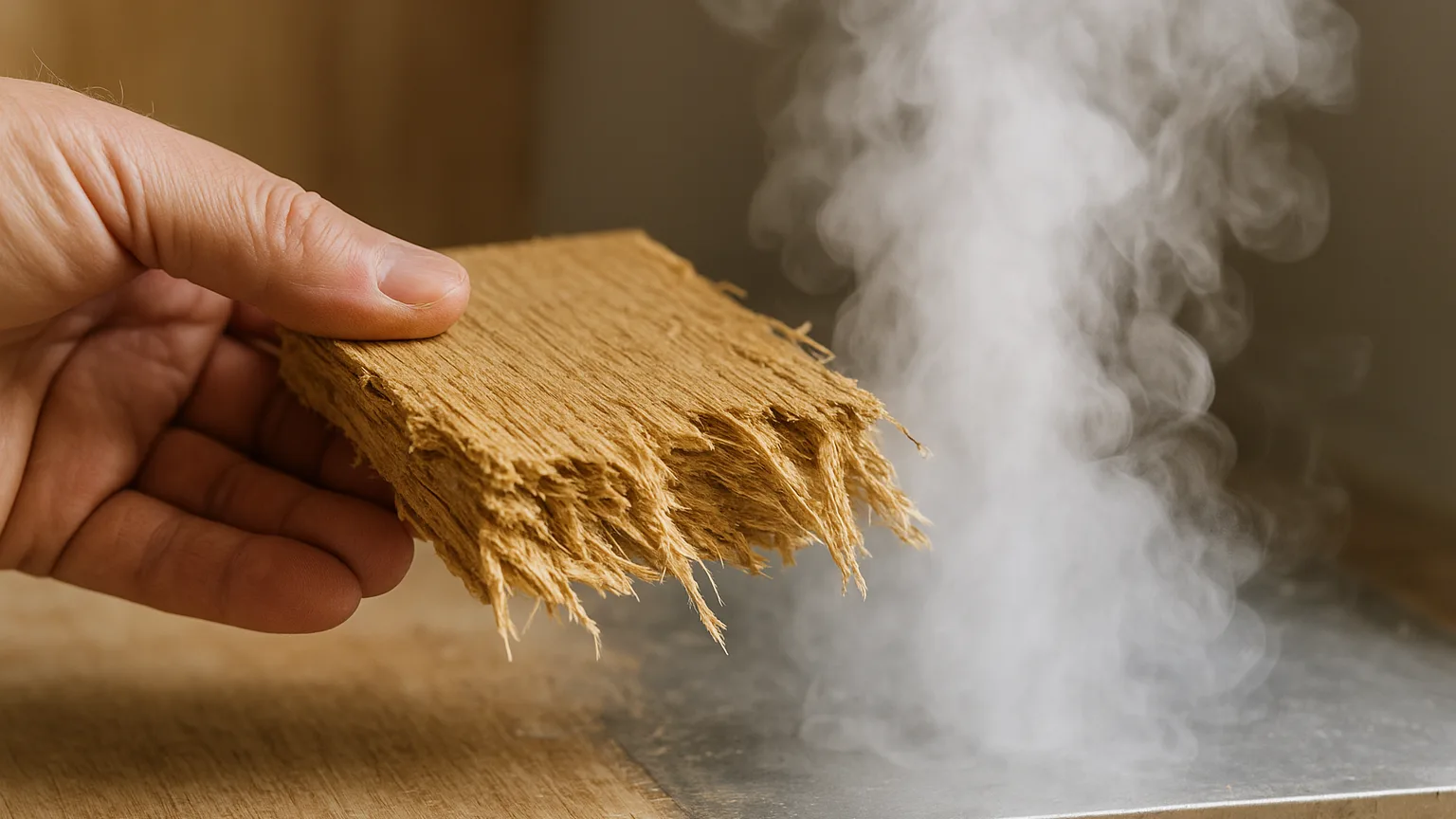
Wood looks solid, but under a microscope it is basically a bundle of hollow drinking straws called cellulose fibers. These fibers are hygroscopic, which means they pull moisture straight out of the air and hold onto it like a sponge. In a bathroom, where a ten minute shower can push humidity past 90 percent in a matter of seconds, that sponge effect becomes a real structural problem rather than just an inconvenience.
Every time the fibers absorb water vapor, they swell. When the room dries out again, they shrink back down. This cycle repeats dozens of times a week in an average household, sometimes multiple times a day in a busy family bathroom. Wood does not return to its exact original shape after each cycle. Instead, microscopic gaps form between fiber bundles, weakening the internal lattice that gives a wood slat its strength and its ability to sit flush inside a frame.
The Mold Connection Nobody Talks About
Cellulose is not just water absorbent, it is also food. Mold spores that land on a damp wood shutter slat have a ready made meal sitting right there in the fiber structure. This is different from moisture damage on a wall or ceiling, because the wood in a shutter is thin, painted, and constantly flexing with temperature swings from hot showers. That flexing creates tiny paint cracks that let moisture straight into the fiber core, and once spores get a foothold, they spread through the grain in a way that sanding and repainting rarely fixes for good.
- Wood slats can absorb moisture up to 28 percent of their dry weight before visible warping appears
- Paint and sealant only slow moisture entry, they do not stop it at joints, hinges, and screw holes
- Grain direction means swelling is uneven, which is why louvers start to stick or will not close flush
- Repeated wet dry cycles create microscopic cracking long before any mold is visible to the naked eye
A family who noticed this firsthand once spent a Saturday morning tracking condensation trails around their window frames, a process documented in a home inspection story about hunting down hidden window leaks. What they found mirrors what happens inside a wood shutter slat, just on a smaller and slower scale, playing out one shower at a time until the damage finally becomes visible.
Inside the Composite Core: A Different Kind of Chemistry
Composite shutter cores are not just plastic imitations of wood. They are engineered materials built from a cellular polymer matrix, usually a foamed PVC or wood polymer blend combined with rigid additives that control how the material expands and contracts. The goal is straightforward: remove the pathways that let water molecules travel through the material in the first place, rather than simply coating the surface and hoping it holds.
Instead of open capillary channels like wood grain, a well engineered composite core has a closed cell structure. Picture millions of tiny sealed bubbles packed together rather than a bundle of open straws. Water vapor has nowhere to travel because there is no connected pathway from one cell to the next. This is the single biggest reason composite shutters hold their shape in a bathroom that swings from cool overnight air to steamy shower conditions within minutes.
The manufacturing process matters just as much as the raw ingredients. During extrusion, the polymer blend is heated, aerated, and cooled under tightly controlled conditions so the cell structure forms evenly across the entire length of the slat. Uneven cooling would leave weak spots where moisture could eventually find a way in, so quality composite manufacturers run continuous density checks throughout production rather than testing only the finished product.
Thermal Expansion That Actually Matches Real Bathroom Conditions
Every material expands when heated and contracts when cooled, but the rate matters. Wood's expansion rate varies depending on grain direction, moisture content, and even which side of the tree the plank came from. Composite cores are manufactured with a consistent, predictable rate of expansion across the entire slat, so a louver that closes flush in December still closes flush in July, whether the bathroom mirror is fogged up or not.
“The difference comes down to how the material is built, not just what it is built from,” says Marcus Feldman, lead product engineer at Direct Buy Blinds. “A closed cell polymer core does not care if the air is saturated with steam, because there is no open channel for that moisture to travel through and cause swelling.”
- Closed cell composite cores show less than 1 percent dimensional change across full humidity swings
- Consistent density throughout the slat prevents the warping seen in natural wood grain patterns
- Built in UV stabilizers prevent yellowing from bathroom heat lamps and direct sunlight exposure
- No organic cellulose content means mold has nothing to feed on even in constant dampness
This is not a coating or a treatment sprayed onto a wood surface after the fact. It is a fundamental difference in how the material is assembled at the molecular level, which is why composite performance holds up over the entire life of the shutter rather than fading after the first few humid summers.

The Building Envelope Connection for Bathroom Shutters
A bathroom shutter does not operate in isolation. It is one small piece of a much larger moisture management system that includes your exhaust fan, window seals, insulation, and even the paint on your walls. Understanding how these pieces work together explains why a moisture engineered composite core matters more in a bathroom than almost anywhere else in the house.
Homes are increasingly built and retrofitted with tighter building envelopes to save energy, which sounds great for heating and cooling bills but creates a side effect worth knowing about. Tighter homes trap humidity longer because there is less natural air exchange with the outside. A discussion of this exact tradeoff appears in an analysis of how energy efficient upgrades change indoor humidity levels, and the same logic applies directly to bathroom fixtures. If your home holds onto moisture longer because of better insulation, the materials inside your bathroom need to handle that extra humidity load without breaking down, a challenge explored further in a look at how monsoon humidity swings demand different shutter slat materials.
What Long Term Performance Data Actually Shows
Manufacturers who test composite cores under accelerated humidity cycling, essentially running years of steam exposure into a matter of weeks, consistently find that closed cell polymer structures outperform even premium hardwoods in dimensional stability. Wood can be treated, sealed, and finished beautifully, but it remains a hygroscopic material at its core. Composite does not fight that same battle because it was never built from organic fiber in the first place.
- Composite shutters typically carry warranties two to three times longer than wood alternatives in wet room applications
- Maintenance drops significantly since there is no repainting or resealing needed to fight moisture intrusion
- Resale value holds steadier because composite shutters do not show the age related warping buyers notice in wood
- Installation tolerances stay accurate for the life of the product instead of shifting within the first year
None of this means wood is a bad material in general. It is a beautiful, versatile choice for dry rooms with stable humidity, and it will likely stay that way for decades in a living room or bedroom. The mismatch only happens when wood is asked to perform in an environment it was never designed to handle, which is exactly the daily reality inside a working bathroom that sees steam, splashes, and temperature swings every single day, a slow failure mode described in detail in The Silent Swell: What's Really Rotting Behind Your Bathroom Shutters.
The Real Takeaway for Anyone Choosing Bathroom Window Coverings
The science here is not complicated once you strip away the marketing language. Wood is an organic, hygroscopic material that swells, shrinks, and eventually breaks down when exposed to repeated humidity cycles, and a bathroom produces more of those cycles than almost any other room in a house. Composite cores solve this problem at the molecular level by removing the open pathways that let moisture cause damage in the first place, which is why they hold their shape, resist mold, and keep working long after wood alternatives start to show their age.
Choosing the right shutter material comes down to matching the product to the environment it will actually live in, not just picking whatever looks good under showroom lighting. For a room that sees daily steam and constant temperature swings, a moisture engineered composite core is not just a nice upgrade. It is simply the material that was built to do the job wood was never designed to handle.
Find the perfect Materials for your project
This section is designed to simplify the process of choosing the right materials, whether for building, remodeling, or decorating, by providing detailed descriptions, comparisons, and practical tips. Here, you'll find valuable insights and expert recommendations to ensure the materials you choose enhance the durability, aesthetic appeal, and functionality of your project.